
Quantum mechanics is one of the most powerful branches of modern physics, but it is also one of the hardest to grasp intuitively. The reason is simple: the quantum world does not behave the way our everyday experience teaches us to expect. In daily life, objects occupy definite positions, move in familiar ways, and seem to exist in the same state whether we observe them or not. At the level of electrons, photons, and atoms, things are very different.
The main reason people find quantum mechanics “strange” is not that the theory is wrong, but that our intuition was built for the large-scale world. We are used to thinking in terms of tables, chairs, balls, cars, and human beings. Quantum mechanics, however, describes nature at a much deeper and smaller level. At that scale, reality does not have to match the habits of common sense.
In this article, we will look at why quantum mechanics seems strange by focusing on two central ideas: superposition and measurement. To make these ideas easier to understand, we will use seven simple analogies instead of heavy mathematics.
What exactly makes quantum mechanics seem strange?
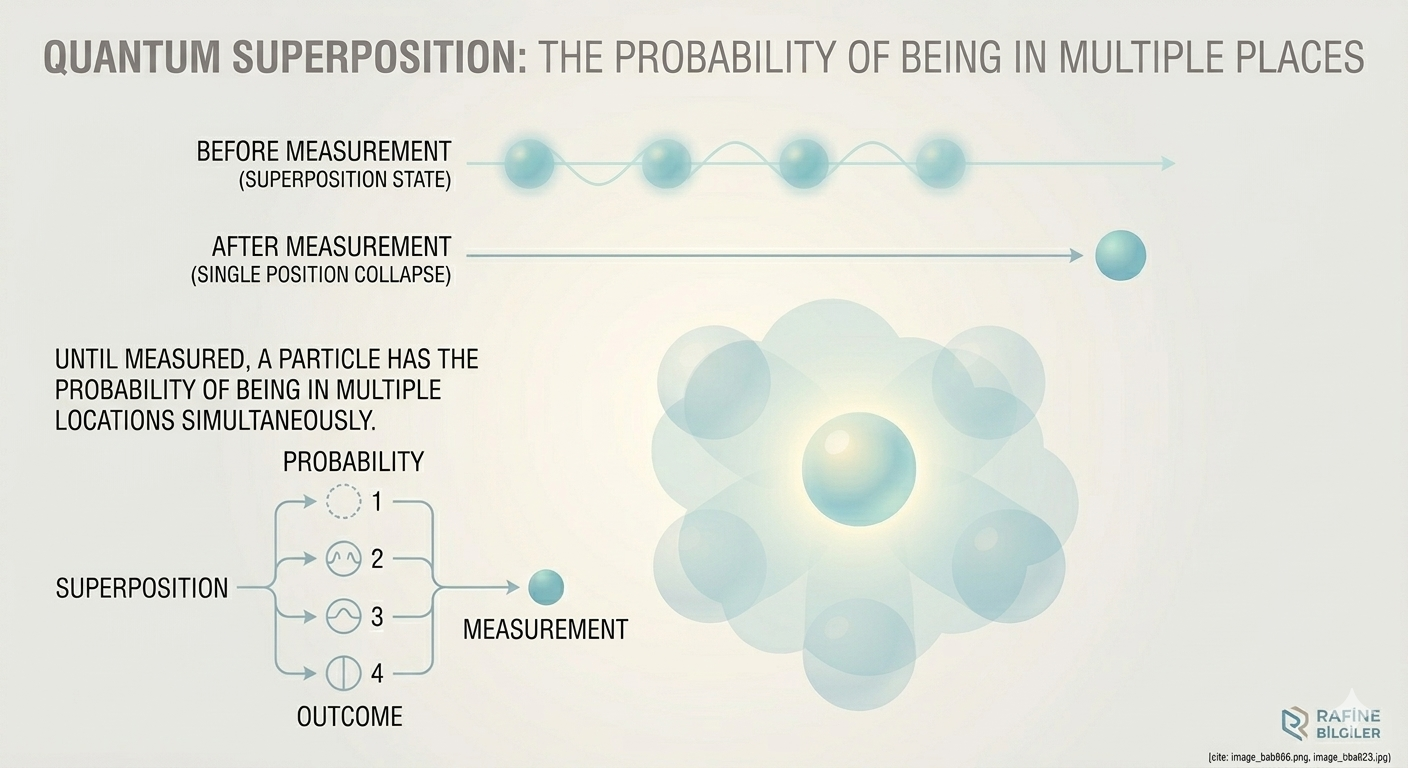
In quantum mechanics, a particle does not always have to exist in a single, definite state in the classical sense. An electron may not be described as being in one exact position before measurement. A photon may not behave as if it took only one specific path. Instead, the system can be described as a combination of multiple possible outcomes. This is what we call superposition.
What makes this especially difficult to accept is what happens during measurement. Before measurement, the quantum system is described in terms of multiple possibilities. Once a measurement is made, however, the system appears to produce only one result. This is where people often pause and ask: “So was it not definite until we measured it?” In the language of quantum mechanics, that question is exactly at the heart of the issue.
Let us move into the analogies.
1. Analogy: A spinning coin
If you place a coin flat on a table, it is either heads or tails. That is the classical picture: one object, one outcome, one definite state.
But imagine throwing the coin into the air and watching it spin. Before it lands, you cannot say that the final outcome is fixed in the same ordinary sense. It is still “on the way” to becoming heads or tails.
Of course, this is not a perfect model of true quantum superposition, because the spinning coin is still a classical object in a definite physical motion. But it gives an intuitive feeling for the idea that the final result is not yet settled from our point of view.
In quantum systems, the deeper claim is stronger: the uncertainty is not only about our lack of knowledge. The system itself is described as a combination of possible outcomes before measurement.
2. Analogy: A car inside thick fog
Imagine a car somewhere inside heavy fog. Because the visibility is poor, you cannot tell exactly where it is. Maybe it is slightly to the left, slightly to the right, or a little farther ahead. This is a classical kind of uncertainty.
Quantum uncertainty may look similar at first, but it is more radical. In the fog example, the car really does have a definite position; we simply do not know it. In quantum mechanics, however, the system is not just hiding a precise answer from us in the same way. Its mathematical description before measurement is genuinely probabilistic.
So classical uncertainty usually means “the answer exists, but we do not know it.” Quantum uncertainty means the system is fundamentally described through possibilities until measurement occurs.
3. Analogy: A traveler taking many paths at once
Suppose a traveler wants to go from one city to another. In classical life, the traveler must choose one road or another. They cannot physically take both paths at the same time.
In quantum mechanics, however, we often describe a particle as if all possible paths contribute to the final result. This is especially clear in the famous double-slit experiment. When electrons or photons are sent toward two slits, they do not behave as if they simply went through one slit in the ordinary classical way. Instead, the outcome reflects the contribution of multiple possible paths.
This is one of the clearest reasons quantum mechanics feels strange. In everyday life, a person cannot walk through two doors at once. But quantum objects are not required to obey the intuitions we developed from the everyday world.
4. Analogy: Multiple notes in music
If you press one piano key, you hear one note. If you press several keys together, you hear a chord. In other words, the sound you hear is not just one note but a combination of several notes.
This can be a useful way to picture superposition. A quantum system can be described not as one single “note,” but as a combination of several possible states at the same time. When a measurement is made, we observe one specific outcome.
This analogy is not perfect, but it helps illustrate an important idea: a quantum state can be a combination, not just a single classical alternative.
5. Analogy: An exam result before it is announced
Imagine that a student has taken an exam. Before the result is announced, the student has either passed or failed, but we do not yet know which. That is still a classical uncertainty.
Many people compare quantum measurement to this situation, but the comparison is incomplete. In the exam example, the result already exists; it is merely unknown to us. In quantum mechanics, before measurement, the system is not always treated as though one hidden classical answer already exists in the same way.
Still, the analogy helps us understand why measurement matters. Before the announcement, many possible outcomes exist in our minds. After the announcement, only one remains. In quantum mechanics, measurement also appears to reduce many possibilities into one observed result.
6. Analogy: Taking a photo versus disturbing the system
In daily life, if you photograph a chair, the chair is not meaningfully altered by the act of observation. We are used to thinking of observation as passive.
But in quantum mechanics, measurement is not just “looking.” To measure a quantum system, some interaction must occur. For example, detecting an electron requires some physical process that exchanges information or energy with the system. That interaction can influence the system itself.
This is why the phrase “the system changes when we observe it” is often misunderstood. The problem is not that human consciousness magically alters reality. The point is that measurement is a physical interaction, not a harmless glance.
7. Analogy: A map showing possible locations
Think of a navigation app with a weak signal. Instead of showing your position as one precise point, it may display you somewhere within a broad zone. In effect, it says: “You are probably somewhere in this region.”
In quantum mechanics, the wave function describes something similar in spirit: a spread of possibilities, with some locations more likely than others. When a measurement is made, the particle is found at one specific location.
This analogy is especially useful for understanding probability distributions. Instead of imagining a particle as a tiny ball sitting at one exact point before every measurement, it is often better to think in terms of a spread of possible outcomes.
What is superposition, exactly?
Superposition means that a quantum system can be described as a combination of multiple possible states at the same time. In simple terms, the system does not always have to be pinned down to one definite answer before measurement.
This sounds absurd at first because we do not see tables, books, or cars behaving this way. A table is either here or there, not both. But when it comes to electrons, photons, spins, and other quantum systems, nature does not follow the large-scale rules our intuition expects.
The important point is this: superposition does not mean “magic” or “nonsense.” It is part of the most accurate mathematical framework we have for describing the microscopic world, and it has been confirmed again and again by experiments.
Why is measurement so important?
In quantum mechanics, measurement is not just a way of revealing a pre-existing classical fact. It is part of the process by which one definite outcome appears from many possible ones.
In classical physics, measurement typically uncovers what was already there. In quantum physics, measurement is tied to the emergence of a single observed result out of a probabilistic description.
This is why the measurement problem remains one of the deepest conceptual debates in physics. Some interpretations describe the wave function as “collapsing.” Others argue that there is no literal collapse in the naive sense, but that our experience only reflects one branch or one effective outcome. Physicists are extremely successful at calculating quantum results, but the philosophical meaning of those calculations is still interpreted in different ways.
Why does quantum mechanics go against common sense?
Because our brains were not shaped to understand the atomic world. Human intuition evolved to handle medium-sized objects, visible motion, distance, danger, and physical interaction in everyday life. None of our ancestors needed to reason about wave functions or electron interference to survive.
That is why quantum mechanics feels foreign. But despite how counterintuitive it is, it works astonishingly well.
Where does quantum mechanics actually matter in real life?
Some people think quantum mechanics is only a strange theoretical subject with no practical use. That is false. A huge part of modern technology depends on it.
For example:
- Transistors cannot be properly understood without quantum physics.
- Lasers rely on quantum processes.
- Semiconductors are explained through quantum energy structures.
- MRI technologies involve quantum behavior at a deep level.
- GPS systems depend on highly precise physics corrections.
So yes, quantum mechanics may seem strange, but it is also one of the most useful theories ever developed.
Conclusion
Quantum mechanics seems strange not because nature is irrational, but because our everyday intuition is limited. Superposition means that a quantum system can be described as a combination of multiple possible states before measurement. Measurement is the physical process through which the system appears to yield one specific result.
These ideas can feel uncomfortable because we do not experience large objects this way. But experiments repeatedly show that the microscopic world does not behave according to the classical rules we are used to.
The first step toward understanding quantum mechanics is not to demand that it behave like everyday life, but to accept that everyday life is only one layer of reality. Once that is clear, quantum mechanics may still feel strange, but at least we begin to understand why it feels that way.